

The closed loop concept
Much of the scientific knowledge accumulated through the intensive study of the brain and its neural functioning has been obtained through an approach often referred to as the “open-loop” approach (see Figure). In these experimental paradigms, the brain is generally explored through its dynamic responses to multiple sensory stimuli presented by experimenters. Since the goal is to record the most “typical” responses triggered by the chosen stimuli, experimental conditions are designed to be as reproducible as possible, in order to minimize potential sources of variability.
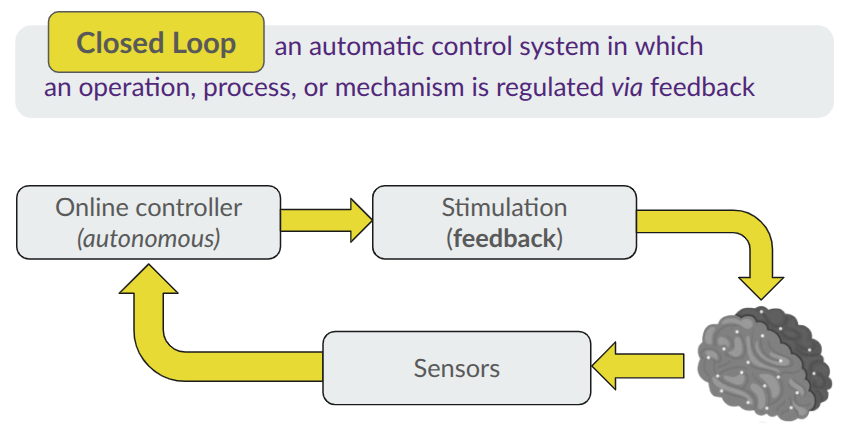
The figure depicts a closed-loop autonomous control system for brain-computer interfaces, consisting of three main components connected by arrows indicating the flow of information.
1. Sensors
The sensors record brain activity in real time. They are in direct contact with the brain (represented by an illustration of a brain on the right).
2. Online Controller (Autonomous Controller)
The autonomous controller processes the data received from the sensors. It is responsible for real-time analysis and decision-making.
3. Stimulation (Feedback)
The system sends stimulation (feedback) to the brain based on the data analyzed by the controller. This stimulation can be used to influence or modulate brain activity.
However, this open-loop approach, while practical, has at least two major limitations. First, the brain is a dynamic system with strong internal dynamics that significantly influence its variability from one trial to the next. This has often led researchers to average their measurements across multiple trials to characterize the “typical” response they are interested in. Second, the conclusions drawn by experimenters may be unintentionally biased, as it is difficult to exercise complete control over sources of variability. For example, recent tests on rodents have shown that the high variability in neural activity in the visual cortex can be explained by micro-movements of the face when they observe visual stimuli. Similarly, in functional MRI experiments, a large number of artifacts have been identified over the past two decades, such as magnetic field instabilities, head movements, and physiological fluctuations, all of which can corrupt responses and thus require rigorous preprocessing steps.
To address some of these issues, this LOOP project proposes to view the brain as part of a closed-loop system, in which neural dynamics (and thus neurons) are regarded as actuators that sample the environment and interact with the outside world (see Figure). Such a paradigm has already been highly successful in the field of control strategies for neuroprosthetic systems as well as in neurofeedback applied to cognitive rehabilitation.