

The LOOP project
The LOOP project brings together the theoretical, technological, and clinical expertise of the University of Lille in the field of neurotechnology, specifically that involved in the various stages of designing, testing, and validating devices capable of mimicking and restoring brain physiology, with the ultimate goal of alleviating severe psychiatric symptoms. The project focuses on the multidisciplinary field of closed-loop systems in neuroscience, which can be understood as automated control systems regulated by feedback. It brings together several partners in Lille who are heavily involved in the European NeurotechEU alliance.
Innovative therapies for neuropsychiatric disorders
The LOOP project will ease the design and use of closed-loop neurotechnologies to relieve hallucinations. Either non-invasive (fMRI, EEG) or invasive (electrode). More importantly, it will also propose ethical guidelines and legal considerations for the use of such devices.
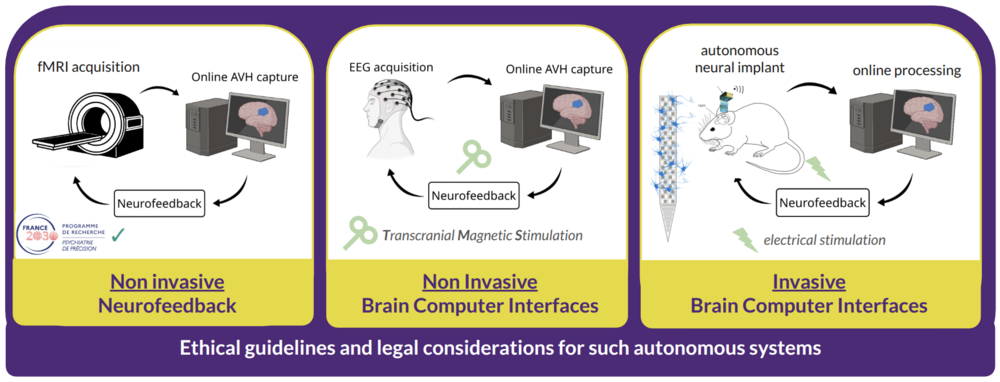
The figure is divided into three sections, each illustrating a different type of brain-computer interface (BCI), classified according to whether they are invasive or non-invasive.
1. Non-Invasive Neurofeedback
- Illustration:
- A functional MRI (fMRI) scanner is used to acquire brain data.
- The data is processed in real time by a computer (Online AVH capture).
- Feedback (neurofeedback) is provided to the user.
- Description:
This method uses non-invasive techniques, such as functional MRI, to record brain activity and provide real-time feedback to the user.
2. Non-Invasive Brain-Computer Interfaces
- Illustration:
- An electroencephalography (EEG) headset is used to acquire brain data.
- The data is processed in real time by a computer (Online AVH capture).
- Feedback (neurofeedback) is provided to the user.
- An option for transcranial magnetic stimulation (TMS) is also shown.
- Description:
This method uses non-invasive techniques such as EEG to record brain activity and provide real-time feedback. It may also include non-invasive brain stimulation techniques, such as transcranial magnetic stimulation.
3. Invasive Brain-Computer Interfaces
- Illustration:
- An autonomous neural implant is inserted into the brain (represented by an array of electrodes).
- Brain data is processed in real time by a computer (online processing).
- Neurofeedback is provided.
- Electrical stimulation is also applied.
- Description:
This method uses invasive techniques, such as the implantation of electrodes in the brain, to record and process brain activity in real time. It also allows for direct electrical stimulation of the brain.
Each section includes a note stating that these systems raise important ethical and legal questions.